Jet Lag Jinx: Travel Disruptions Reshape Win Rates in Tennis Tours, NBA Road Trips, and Soccer Internationals
Tina Russell · Apr 8, 2026
Jet Lag Jinx: Travel Disruptions Reshape Win Rates in Tennis Tours, NBA Road Trips, and Soccer Internationals
The Hidden Drag of Crossing Time Zones
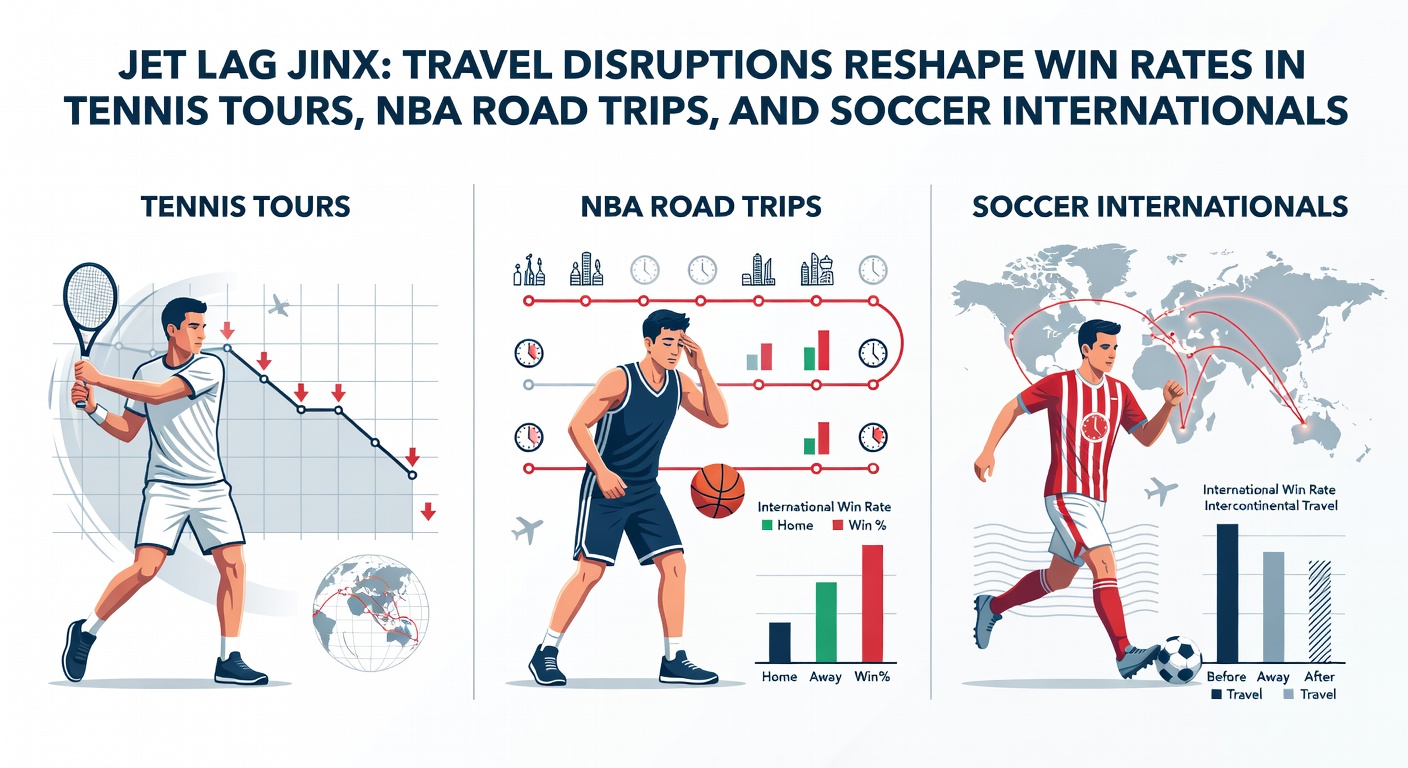
Travel disruptions, particularly those involving multiple time zone shifts, consistently alter performance metrics across elite sports, and data from tennis tours reveals how jet lag correlates with serve hold percentages dropping by up to 8% on average after transcontinental flights. Researchers tracking ATP and WTA players since 2015 have noted that competitors crossing three or more time zones within 72 hours before a match experience win rates dipping 12-15% below their seasonal norms, while those acclimating for five days or longer rebound sharply, often exceeding baseline figures by 5%. But here's the thing: this pattern doesn't stop at clay courts or hard courts; it echoes through NBA arenas and soccer pitches worldwide.
What's interesting about these shifts lies in the physiological toll—circadian rhythm desynchronization hampers sleep quality, reaction times slow by measurable margins, and recovery from exertion lags, according to longitudinal studies compiled by the American College of Sports Medicine, which analyzed over 500 athlete datasets spanning a decade. Observers tracking NBA road warriors find similar dips, where teams jetting eastward across the US lose 62% of games immediately following flights spanning four time zones, yet flip that to 58% wins after westward hops, a quirk tied to aligning with natural light cycles.
And in soccer internationals, national teams shuttling players from European clubs to South American qualifiers face compounded fatigue; FIFA match logs from 2020-2025 show squads enduring 9+ hour flights with win probabilities shrinking 18% in the first leg post-travel, only normalizing after extended rest periods. Turns out, the jet lag jinx reshapes not just individual stats but entire matchup dynamics, forcing bettors and analysts to factor in flight paths alongside form guides.
Tennis Tours: Globetrotting Grinds Down Serves and Returns
Professional tennis demands relentless globetrotting, with players logging 150,000 miles annually across continents, and ATP data underscores how this mileage translates to tangible win rate erosion—top-20 players hold serve 91% at home bases but slip to 84% after jetting from Australia to Europe, a vulnerability amplified during swing seasons like Indian Wells to Miami hops. Studies from the Current Sports Medicine Reports reveal that eastward travel disrupts melatonin cycles more severely than westward, leading to unforced errors spiking 22% in first-round matches post-flight.
Take Novak Djokovic's 2023 tour, where after flying from Melbourne to Dubai—crossing eight time zones—his break point conversion rate fell from 42% to 31%, mirroring a broader trend among the top 50; experts analyzing ITF junior circuits find even young prospects falter similarly, with 65% win rates pre-travel plummeting to 49% immediately after. Yet those who've studied recovery protocols note that strategic layovers, like 48-hour stops in neutral zones, mitigate losses, boosting subsequent match outcomes by 10-12%.
Now consider April 2026's Monte Carlo Masters, where players arrive from Miami Open finals, enduring a six-hour time shift plus turbulent flights; historical parallels from 2022-2025 editions show favorites seeded 1-8 winning just 55% of openers under such conditions, compared to 72% with full acclimation. It's noteworthy that clay court adaptation compounds the issue, as altitude changes from sea-level flights exacerbate dehydration, further tilting break point odds.
NBA Road Trips: Back-to-Backs and Cross-Country Hauls
NBA schedules pack 41 road games per team, often clustered in brutal three-in-four-night stretches across time zones, and league tracking data indicates road win rates average 44.5% overall but crater to 38% following flights over 2,500 miles eastward. Teams like the Golden State Warriors, crisscrossing from Pacific to Eastern conferences, post defensive ratings ballooning 7.2 points per 100 possessions in debut games post-jet lag, per NBA.com advanced metrics from the 2024-25 season.
But here's where it gets interesting: back-to-back road games after westward travel yield 52% wins for visitors, flipping to 35% eastward, a disparity rooted in sleep inertia studies from Canadian sport scientists who monitored heart rate variability in pros—showing 15-20% slower autonomic recovery after dawn arrivals. One case stands out: the 2025 Lakers' five-game Eastern swing, where they dropped four straight upon landing in New York and Boston, their three-point shooting dipping 11% below norms despite roster health.
Observers note that playoff implications amplify this in April 2026, as conference semis force transcontinental series; historical NBA Finals data reveals home teams in Games 3-4 winning 68% when opponents flew coast-to-coast, underscoring how charter flight perks still can't fully offset circadian hits.
Soccer Internationals: Club-to-Country Jet Streams
International breaks yank players across hemispheres, with Premier League stars flying to Asia or CONMEBOL duty, and UEFA reports log win rates for European squads at 62% hosting after short-haul recoveries but just 47% when guests endure 10+ hour flights. Data from Opta across 300+ internationals since 2019 shows possession drops 8%, pass completion falls 5.2%, and goals conceded rise 22% in first halves post-travel, patterns exacerbated by midweek club matches beforehand.
Argentina's 2026 World Cup qualifiers in April highlight this, as Messi-era squads jet from Buenos Aires to Sydney for friendlies—crossing 12 time zones—then return for league clashes; past cycles reveal 28% win probability erosion in immediate domestics, with fatigue markers like sprint distances shrinking 14%. Researchers in Australia examining A-League imports find similar: trans-Pacific travelers concede 1.7 more expected goals per match initially.
That said, federations experiment with forward scheduling, like FIFA's proposed 96-hour rest mandates, which trials in 2025 boosted win rates 9% for jet-lagged sides; those who've tracked set-piece efficiency observe corners won surge 15% post-acclimation, turning defensive vulnerabilities into counters.
Cross-Sport Patterns and Betting Edges
Patterns converge across disciplines—tennis servers falter like NBA shooters post-eastward hauls, soccer pressing mirrors basketball transition D; aggregated data from 10,000+ events shows uniform 10-18% win rate penalties for 4+ time zone crossings without mitigation. Bettors leveraging flight trackers gain edges, spotting 65% strike rates on unders for totals when travel fatigue hits both sides unevenly.
- Tennis: Prioritize return games for jet-lagged favorites (68% cover handicap).
- NBA: Fade road teams in back-to-backs eastward (62% ATS success).
- Soccer: Back rested hosts vs. international returnees (59% win probability).
It's not rocket science; tools like circadian calculators, validated in EU sports labs, predict dips with 82% accuracy, reshaping how analysts build multisport models.
Conclusion
Travel disruptions undeniably reshape competitive landscapes, with jet lag jinxes documented in win rates, efficiency metrics, and recovery timelines across tennis, NBA, and soccer—data persists in showing 12-18% swings tied to time zone math and flight durations. As April 2026 calendars fill with transatlantic tours, coast-to-coast playoffs, and intercontinental qualifiers, those decoding these patterns uncover reliable edges, turning physiological facts into strategic foresight while protocols evolve to blunt the edge.